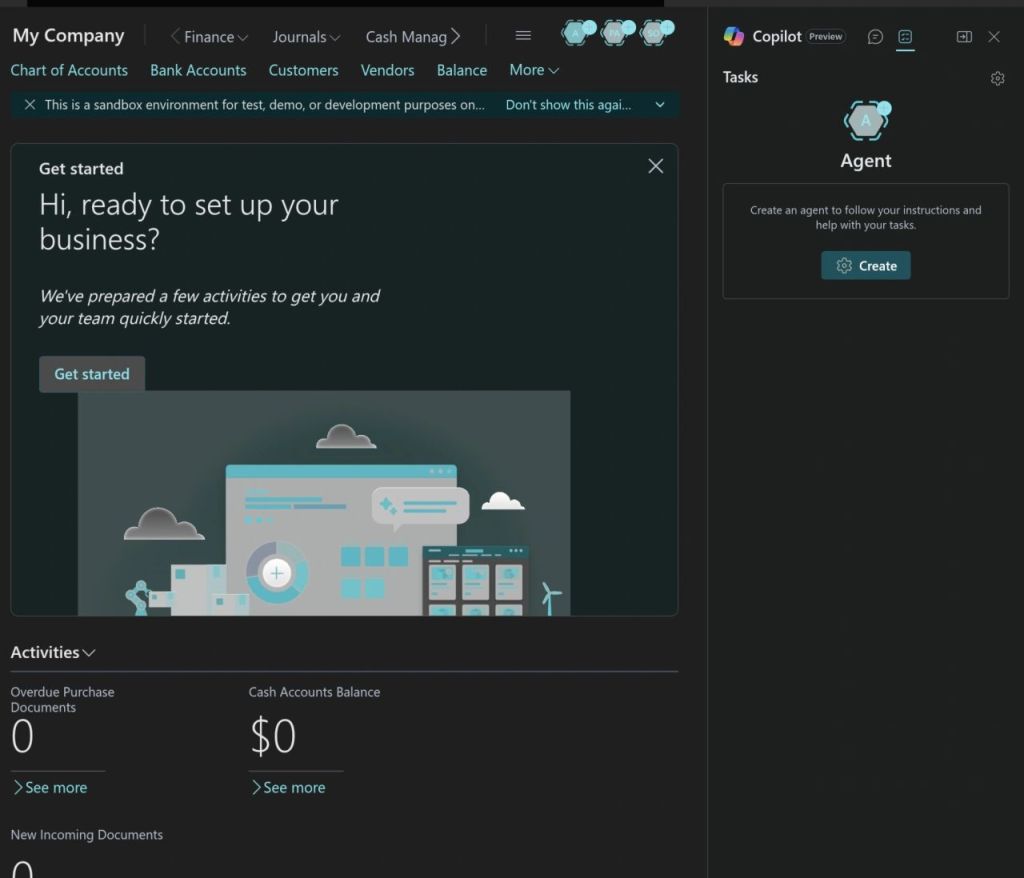
Artificial Intelligence is rapidly expanding inside enterprise systems. With Microsoft Dynamics 365 Business Central v27.4, Microsoft now exposes a first-class agent creation capability — allowing you to define, configure, and run intelligent agents directly inside your ERP environment.
In this blog, we’ll walk through how agents work, the creation experience based on what’s available in the product today.
🚀 What Are AI Agents in Business Central?
In Business Central, AI agents are software assistants that can:
- Understand natural language instructions
- Execute business tasks against Business Central data
- Follow configured rules and permissions
- Operate autonomously or with human review
These agents sit at a higher abstraction layer than traditional workflows — they interpret intent and then coordinate actions across standard Business Central APIs, pages, and logic.
🛠 Step-by-Step: Creating an Agent in Business Central
Here’s a distilled implementation walk-through based on the video and documentation:
1. Enable Agent Capabilities
Before you can create agents, you must:
- Enable Custom Agent capability in your Business Central environment
- Have a sandbox tenant for experimentation
- Ensure you have relevant permission sets such as AGENT-ADMIN and AGENT-DIAGNOSTICS applied to your user account
2. Start the Agent Wizard
Once enabled:
- Click the “Agent” icon in the role centre
- Choose Create New Agent
- Select a template (e.g., Sales Validation) or start from scratch
- Provide:
The installer guides you through setting up:
- Purpose
- Profile
- Permissions
Agents are treated like users, so they must have clear permissions defining what Business Central data they can access and act on.
3. Define Agent Instructions
This is the heart of the agent. Instructions are plain-language “task definitions” that guide what the agent should do when triggered.
A basic instruction structure looks like:
- Introductory purpose
- Step-by-step tasks
- Expected output or result
Example :
“You are a Business Central agent. When invoked, check all overdue receivables and create a work list of customers where the balance exceeds credit terms.”
Agents use this instruction to orchestrate actions, call APIs, or run logic — all while respecting security.
4. Configure Execution Profile
Each agent runs under a specific profile:
- Choose standard or custom roles used in Business Central
- Profiles determine UI access and actions available to the agent
- Permissions are tied to the profile
Profiles limit what the agent can read or write — essential for governance.
5. Test and Activate
Once configured:
- Use the Agent Task Playground to simulate tasks
- Review output and refine instructions
- When ready, activate the agent
- The agent can run immediately or wait for a trigger
In preview today, scheduling and automated triggers are limited — most agents are started manually or via designated events.
📍 Real Business Examples
Agents being highlighted in Business Central include:
🔹 Sales Order Agent
- Monitors a designated email inbox
- Parses incoming customer requests
- Locates or creates the customer record
- Verifies item availability
- Generates and sends quotes or orders via email
- Keeps the human reviewer in the loop for approvals and changes
This helps sales teams minimize manual order entry by automating standard order processing tasks.
🔹 Payables & AP Agents
Similar to sales agents, agents can automate Accounts Payable workflows by:
- Monitoring invoice email inboxes
- Extracting invoice data using AI
- Drafting vendor invoices inside Business Central
- Letting users review and finalize postings
This frees AP teams from repetitive data entry and improves efficiency.
AI agents in Microsoft Dynamics 365 Business Central are more than an experiment — they’re a new paradigm for embedding intelligence inside operational ERP processes. Rather than writing bespoke automation, you define business intent, and the system interprets and operationalizes it — provided you set the rules, permissions, and expectations correctly.
 Ammolh Saallvi Blog